
New Haven County Sex Offender Checks
The Connecticut Sex Offender Registry, managed by DESPP and Connecticut State Police, is the authoritative state source. It covers public registration information required by Connecticut law. New Haven County has no operating county sheriff or county registration office, so searches and registration duties do not run through a county agency. Local police can receive a safety report, but the state registry remains the public lookup channel.
Start with the Connecticut registry for a New Haven name, city, ZIP code, or address-based search. Use the U.S. Department of Justice’s NSOPW only when the question crosses state or territorial lines. A registry result should be verified on the originating jurisdiction’s official profile. A public court search can add case context, but it cannot replace the registry’s current status information.
New Haven County NSOPW Registry
The state registry and the National Sex Offender Public Website serve different ranges. Connecticut’s official system is the closest source for an in-state profile, current state status, and state-specific notice. NSOPW searches participating public registries across jurisdictions. It is useful when someone has moved, uses an alias, or may be registered outside Connecticut.
The official NSOPW image illustrates the national cross-jurisdiction layer.
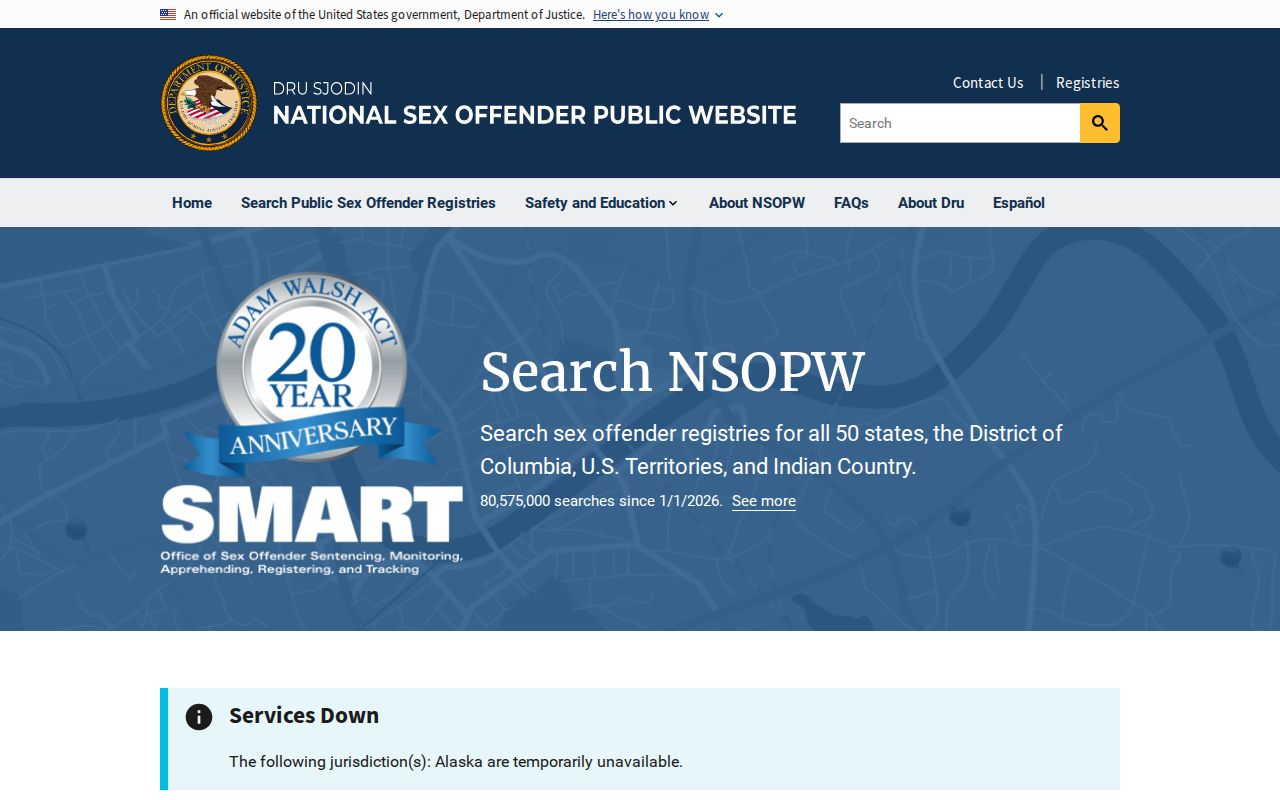
A national match is a lead, not the final record. Open the source jurisdiction’s official profile, compare lawful identifying details, note the date checked, and follow that jurisdiction’s warning and reporting instructions. Never rely on a copied profile or third-party map.
Connecticut Sex Offender Registry Searches
Enter through the Connecticut State Police registry hub. Accept the live conditions or disclaimer if prompted. Search controls can change, so read the current interface before entering data. Partial-name behavior, available map radii, and list or map controls should not be assumed from an older screen.
- Open the official DESPP registry entry point and review its lawful-use notice.
- Choose a name search or a location mode using city, ZIP, or a valid Connecticut address.
- Review the result list carefully, using aliases and physical details without assuming that a name alone identifies a person.
- Open the official profile, read the offense and registration fields, and report suspected noncompliance to police rather than confronting anyone.
The documented controls provide several ways to focus a New Haven County lookup:
| Field or mode | Type | Required | Use |
|---|---|---|---|
| Last and First Name | Text | Required for name mode | Test current partial or exact behavior on the live form |
| City or Town | Dropdown or text | Location mode | Select New Haven or another local municipality |
| ZIP | Five-digit text | Location mode | Focuses a Connecticut postal area |
| Address and Radius | Address plus radius | Location mode | Use a valid Connecticut address and the radii offered live |
| Map or List | View control | No | Display depends on the current interface |
| Search or Reset | Button | As needed | Conditions may need acceptance first |
New Haven County Registry Alerts
Connecticut’s official launch materials describe confidential, free email proximity notifications tied to an address. A notice may be sent after an address change reaches the registry. The system also described specific-person and mapped radius searches around a home, school, childcare site, or park. The current registry entry point should control which alert and radius options are available now.
An alert is a prompt to review the current official profile. It is not a finding that a new crime occurred. Address information can change, and map pins can lack the context contained in the full profile. Use the notice for awareness and practical safety planning. Do not circulate private household claims or encourage neighbors to confront anyone.
Registry Profiles: What They Show
A Connecticut public profile combines identity, offense, and registration information that state law permits for public safety. It does not reproduce the full police report, evidence file, court transcript, or every fact from the underlying prosecution. Victim identity and treatment information are not public. A photograph or address should never be detached from the current official status and warning.
| Name and Aliases | Published name forms and aliases used to help distinguish profiles |
|---|---|
| Photo and Description | Photograph, physical descriptors, and scars, marks, or tattoos when public |
| Residence | Reported public address detail or location granularity allowed by law |
| Offense | Description, statute, jurisdiction, conviction or release information, and an authorized offense summary |
| Registration | Term, status, identifiers, verification, and noncompliance information when public |
| Other Registrations | Vehicle, school, or work-related data when Connecticut law makes it public |
| Agency Contact | Official source for status questions or suspected noncompliance |
Section 54-256 permits an offense summary that can include a victim’s age and sex and a specific offense description, but not the victim’s identity or treatment details.
New Haven County Registry Alias Checks
A shared surname or alias is not enough to identify a registrant. Compare the photograph, physical description, reported location, offense jurisdiction, conviction information, and registration identifiers that the profile lawfully displays. Recheck the official page rather than a screenshot because status and address information can be updated.
A court docket may help confirm the underlying conviction, but online court information has separate display rules and time limits. Registry inclusion is a statutory status. It is not equivalent to every sexual-offense conviction that might appear in a normal case lookup, and a court no-result does not cancel a current official registry profile.
Registration Levels and Duties in Connecticut
Connecticut does not use a simple public Level 1, Level 2, and Level 3 ladder for these profiles. Duration depends on the statutory offense category, conviction date, prior qualifying history, and special rules. The common framework includes ten-year and lifetime duties. The current statute and official notice control an individual case.
The official Connecticut statutes shown in the captured source set out the offense-based framework.
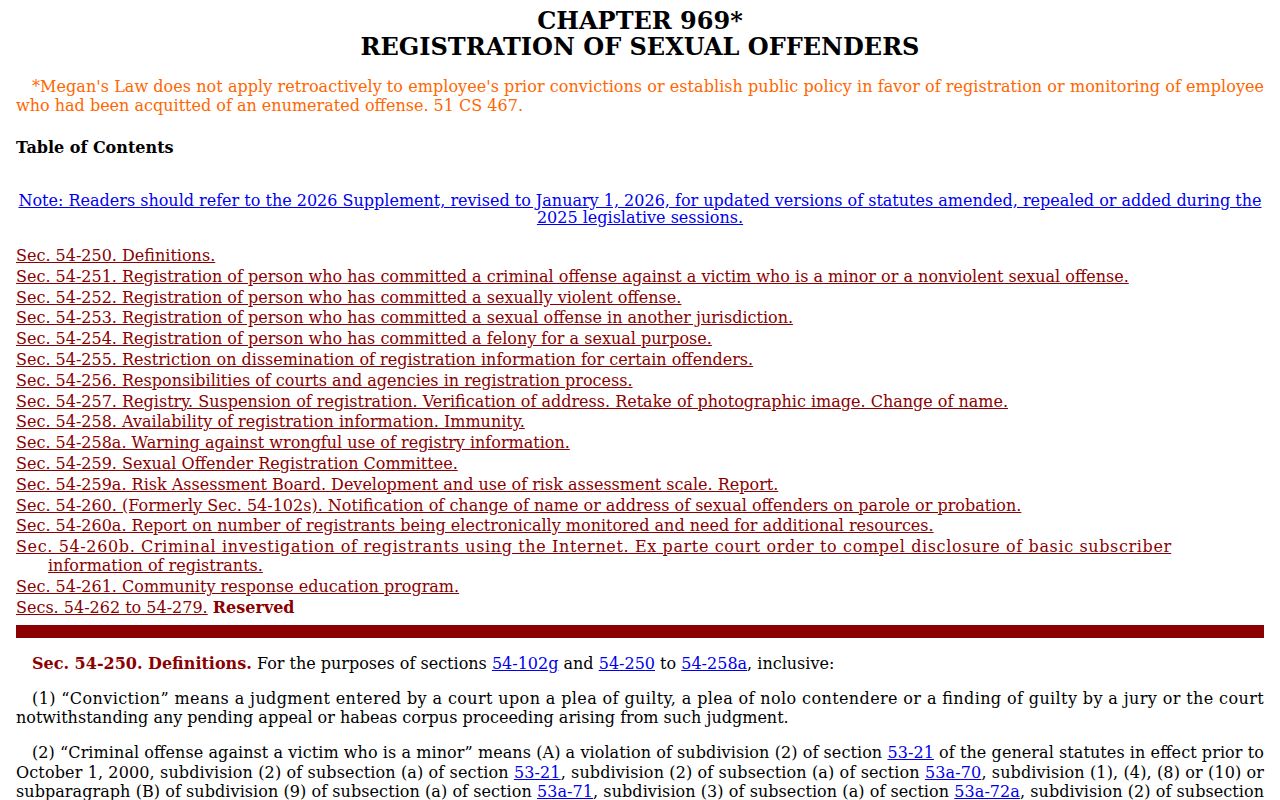
The main statutory routes can be summarized without inventing risk tiers:
| Statutory route | General duration or treatment | Authority and caution |
|---|---|---|
| Criminal offense against a minor or nonviolent sexual offense | Generally 10 years | CGS §54-251; prior qualifying convictions and specified offenses can require life |
| Sexually violent offense | Life | CGS §54-252 |
| Out-of-jurisdiction registrant | Register without undue delay after Connecticut residence | CGS §54-253; operational form states within five business days |
| Felony committed for a sexual purpose | Generally 10 years, subject to details | CGS §54-254; current exceptions must be checked |
Section 54-258 makes the registry public during normal business hours and requires online access, subject to confidential or restricted categories.
New Haven County Registration Office
The State Police Sex Offender Registry Unit is at 1111 Country Club Road, Middletown, CT. The official DPS-694-C-3 form lists initial in-person registration Monday through Friday from 9 a.m. to 3 p.m., excluding federal and state holidays. The unit can be reached at 860-685-8060, by fax at 860-772-1730, or at SORU@ct.gov.
State Police Registry Unit
1111 Country Club Road
Middletown, CT
860-685-8060
Initial registration: Monday-Friday, 9-3
The form collects name, release date, SPBI number or date of birth, docket number, residence, deadline route, completing agency, releasing agency, and required signatures. It states three days after release for one route and without undue delay, operationally within five business days, for an out-of-jurisdiction registrant. Registration questions should go to the unit, not a county sheriff that does not exist.
New Haven County Noncompliance Reports
Suspected failure to register or update information belongs with Connecticut State Police or local law enforcement. Give the official profile identifier and concrete observation without investigating, following, contacting, or confronting the person. Call emergency services only when there is an immediate danger. A stale address or missed detail should be reported as a concern, not announced as a proven new offense.
The profile’s agency contact is the best first route for a status question. Preserve the URL and date checked. If the concern spans states, use NSOPW to find the originating official registry, then follow that jurisdiction’s reporting instructions. Public discussion should avoid victim details and unverified claims.
Using Registry Information Lawfully
The registry supports community awareness and personal or family safety planning. It does not authorize punishment, exclusion, threats, surveillance, or harassment. Connecticut’s warning protects registrants and other people, including family and household members. Public status also does not remove ordinary privacy and safety duties toward neighbors.
Misuse can lead to prosecution: CGS §54-258a warns that anyone who uses registry information to injure, harass, or commit a crime against a registrant or another person is subject to criminal prosecution. Do not threaten, intimidate, or confront anyone.
Verify every material detail on the official current profile. Report a suspected violation through law enforcement. For an underlying public prosecution, use the New Haven County court case lookup, while remembering that court display and registry status follow different laws.