
Criminal Court Cases in New Haven
Connecticut has one Superior Court system with administrative locations, not a New Haven County court government. New Haven city arrests generally move to Geographical Area No. 23 for geographical-area criminal business. Judicial-district criminal work can be heard at the New Haven Judicial District. There is no separate municipal criminal trial court. The State's Attorney prosecutes charges, while the Superior Court clerk keeps the case file, docket, pleas, motions, disposition, sentence, and public warrant or bond entries.
The court location matters. GA 23 is at 121 Elm Street, and more serious Part A or Judicial District work may be at 235 Church Street. A docket number is the safest key because a common name can point to more than one person. Confirm the court, arrest or return date, charge, and case status before treating a result as a match.
New Haven Court Locations
New Haven court case records are split by function, not by a city-versus-county line. The official Judicial Branch clerk directory should be checked before a visit because assignments can change. GA 23's clerk can be reached at 203-789-7461 during the published Monday through Friday, 9 a.m. to 5 p.m. schedule. The New Haven Judicial District chief clerk is at 235 Church Street and can be reached at 203-503-6800.
Superior Court GA 23
121 Elm Street
New Haven, CT 06510
203-789-7461
Geographical-area criminal cases
New Haven Judicial District
235 Church Street
New Haven, CT 06510
203-503-6800
Judicial-district criminal work
The Public Information Desk at 121 Elm can help with calendars, electronic lookup, forms, public-access equipment, and language help. It does not give legal advice. Bring the docket number when known and ask which clerk has the exact New Haven criminal file.
New Haven County Case Record Searches
The free Connecticut Criminal/Motor Vehicle Case Look-up separates pending cases, convictions, daily dockets, docket-number searches, attorney appearances, and public arrest warrants. A conviction search does not replace a pending-case search. Online status is useful for navigation, but a certified disposition from the clerk is the stronger proof of an outcome.
- Choose pending case, conviction, daily docket, docket number, or warrant mode based on the question.
- Use the docket number when possible. Otherwise search the defendant name and compare available birth-year cues.
- Select New Haven GA 23 or New Haven JD as appropriate, then confirm category, charge, and dates.
- Open the public entry and read status, plea, disposition, bond, event, and sentence fields without assuming an allegation is a conviction.
- Contact the correct clerk for a certified disposition, a copy, or a location-limited search when the record is absent online.
| Search mode | Key field | Use | Limits |
|---|---|---|---|
| Pending by defendant | Last name begins with; birth year | Open public cases | Erased and nonpublic cases excluded |
| Conviction by defendant | Full name; initial; birth year | Public conviction entries | Generally no more than ten years online |
| Docket number | Docket number | Precise case match | Requires the identifier |
| Daily docket | Court or last name | Scheduled appearances | Location and date dependent |
| Attorney or firm | Juris number | Public appearances | Professional key required |
New Haven Docket Numbers Matter
A docket number beats a common name. Names can be misspelled, abbreviated, or shared, while the docket ties the case to a court location and event stream. If the number is not known, search more than one portal mode, then compare the charge statute, arrest date, file or return date, status, and court. Protected identifiers are not reliable public identity keys.
The Judicial case menu also lists historical or administrative court labels. Use the current directory to confirm where the present file belongs. A New Haven court entry should not be attributed to a person from a name match alone.
The official Connecticut case lookup shows how the search families are separated.
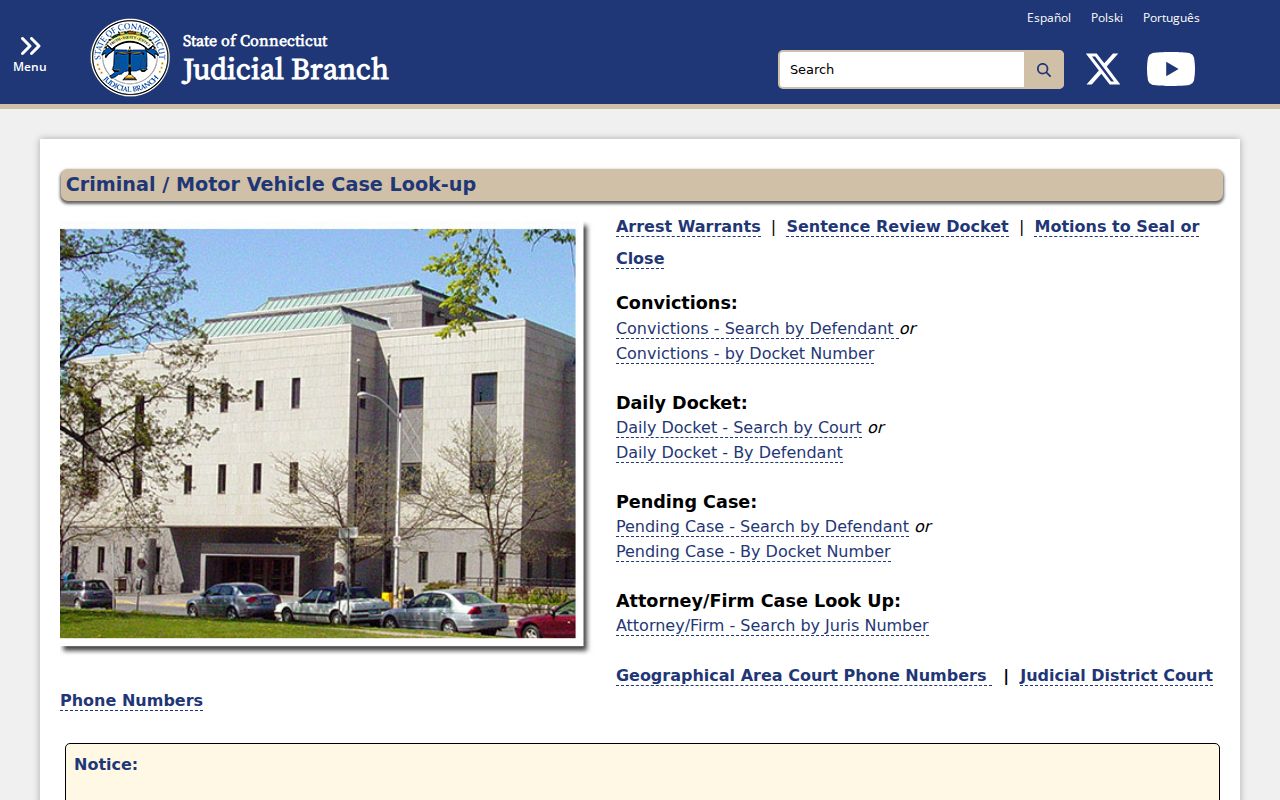
That separation is why pending, conviction, and daily-docket modes should each be checked when the timing is unclear.
Note: Record the search date because Connecticut Judicial information changes daily as courts correct, erase, pardon, or update cases.
What a Criminal Case File Contains
A New Haven criminal case entry can identify the prosecution and show how charges moved through court. It does not always provide downloadable pleadings or evidence. The official public-data description says bulk records contain basic case facts, important dates, parties, appearances, motions, pleadings, and companion-case data, but electronic documents are not included.
| Header | Docket number, court, State v. case name, status, and case type |
|---|---|
| Charges | Statute, description, offense class, plea, disposition, and disposition date |
| Dates and events | Arrest, return, next event, arraignment, continuance, plea, disposition, and sentencing |
| Bond | Amount, type, and status when public |
| Sentence | Incarceration, suspended execution, probation, fine, or other public terms |
| Access limits | Sensitive identifiers and protected parties omitted; documents not uniformly downloadable |
For the event narrative or body-camera material, ask NHPD. For the adjudicated result, ask the court clerk. The difference is central to any New Haven court case lookup.
The Judicial Branch's court record FAQ documents the clerk-copy path.
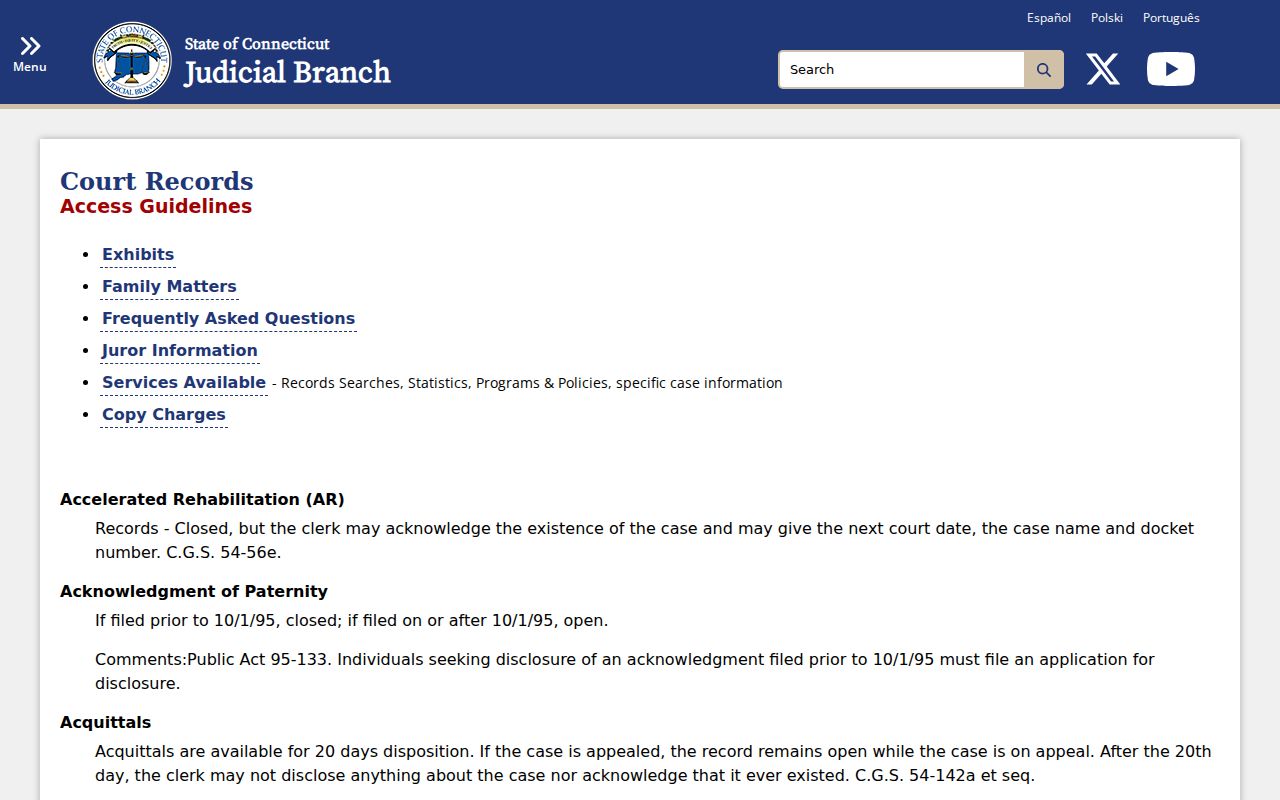
The clerk remains essential when the online index lacks the document or certification a reader needs.
New Haven Clerk Copy Searches
Older and nondigitized court records require a written search to the court location where the arrest occurred. Include the person's name, date of birth, and the arrest or disposition date if known. The official court-record access instructions stress that a search is limited to that court location. A letter sent to the wrong clerk may therefore miss the file.
Public court records cost $1 per page. Administrative records cost $0.25 per page. Ask separately about certification and describe the exact document needed, such as a disposition or judgment. The clerk search is also the right fallback when a New Haven case is outside the web display window or when electronic documents are unavailable.
The Judicial public-data service serves bulk and custom data needs, not a substitute for a certified individual disposition. Its lack of attached electronic documents explains why an index result may still require direct clerk contact.
The official public data catalog distinguishes data products from case-file copies.
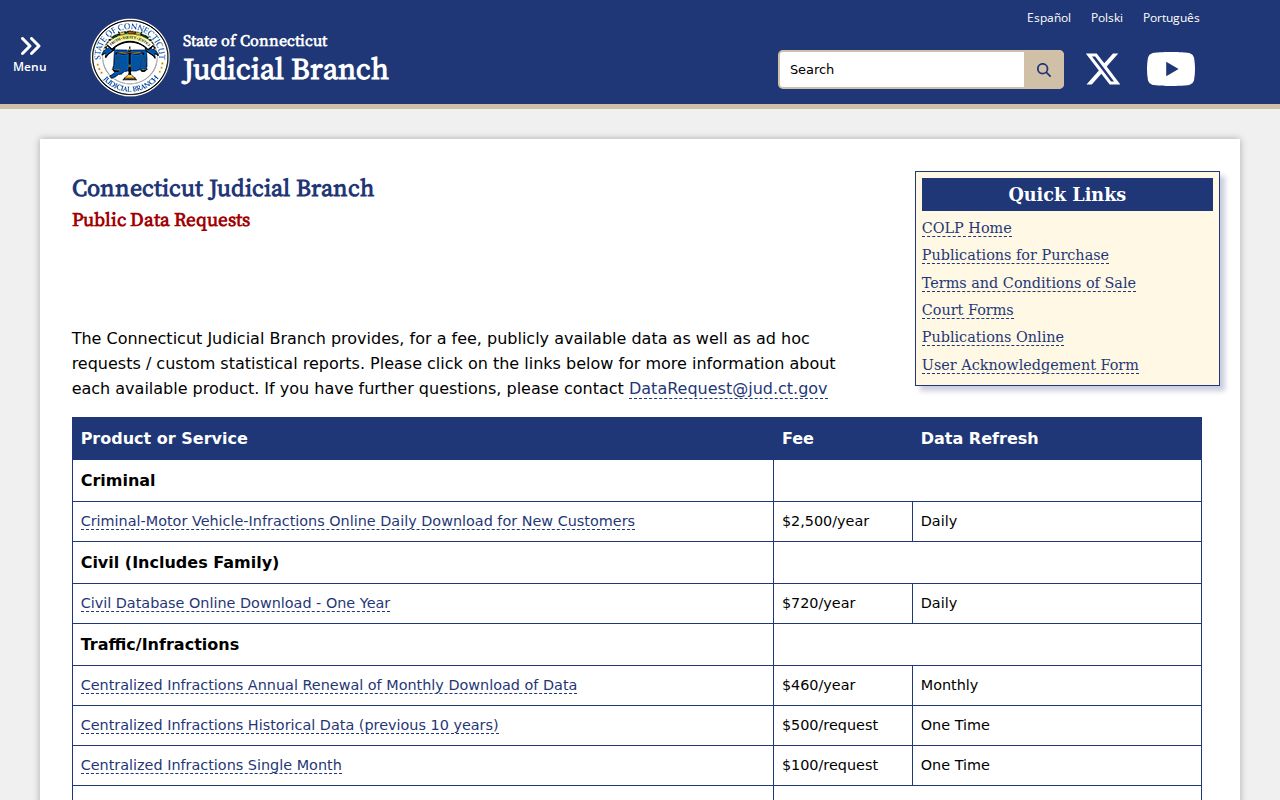
For one New Haven outcome, the correct court clerk is usually the more direct and authoritative route.
Criminal Case Stages in New Haven
A New Haven prosecution may begin with an investigation, an arrest, or a warrant. Prompt presentment and a bond decision follow. Prosecutors then decide which charges continue, and those filed charges can differ from arrest counts. At arraignment, the accused responds to the charge. Discovery and pretrial motions prepare the case for a plea or trial. The court then records the disposition and sentence, followed when relevant by sentence review, appeal, probation, or DOC custody.
Case flow: Charges Filed → Arraignment → Pretrial → Plea or Trial → Disposition → Sentencing
The flow distinguishes allegations from outcomes. A daily docket signals an appearance. A pending status means the matter is unresolved. Neither is proof of guilt.
New Haven Case Outcome Terms
Connecticut docket terms carry distinct meanings. Reading them correctly prevents a court case search from turning a charge into an outcome.
- Nolle prosequi
- The prosecutor declines to proceed, subject to Connecticut erasure timing.
- Dismissal
- The case or charge ends without a conviction.
- Acquittal
- The finder of fact returns a not-guilty result.
- Disposition
- The recorded outcome of a charge.
- Vacated
- A judgment has been set aside.
A plea is the defendant's formal response, while a sentence is the consequence imposed after a guilt judgment. Check each charge line because one case can contain several counts with different outcomes.
Access Rules for Case Records
New Haven court files are subject to Judicial Branch rules rather than city FOIA. Juvenile and youthful-offender matters are confidential, erased cases are removed, and protected parties or identifiers may not appear. Public conviction entries generally remain online no more than ten years after sentencing and may disappear sooner under Connecticut Practice Book rules. A missing web result is not proof that no historical event existed.
CGS §54-142a governs erasure and its legal effect. CGS §54-142e requires purchasers of public criminal data to obtain updates and permanently delete erased matters before redisclosure. Those rules can change yesterday's New Haven search result.
New Haven Docket or Narrative
A court docket and police report answer different questions. The New Haven docket shows prosecution: filed charges, appearances, pleas, motions, disposition, and sentence. The NHPD report describes the investigated event, parties, reported conduct, officer action, and releasable evidence details. Charges can change between those records.
Use the clerk for a certified outcome. Use NHPD for the event narrative. Use SPBI for a fingerprint-linked statewide self-review. Keeping those channels separate makes New Haven County court case lookup results easier to verify and correct.